Banner

Banner
My Rover as it goes airborne cresting a hill on Eloo

Monday, April 14, 2014

To The Mun Alice!

In this post I present the series that eventually carried Jebediah to his first successful Mun Landing. I called the class To The Mun Alice! In case you don't understand it: Years ago there was a television program called The Honeymooners. The title character Ralph Kramden (Jackie Gleason) often threatened his wife Alice with lines like, "One of these days... BANG, ZOOM! Straight to the moon!" Not very politically correct but it seemed to fit.

Many of the lessons learned from these ships were applied to my later planetary missions. These rockets were all created in Kerbal Space Program 0.23.


First up is To The Mun:

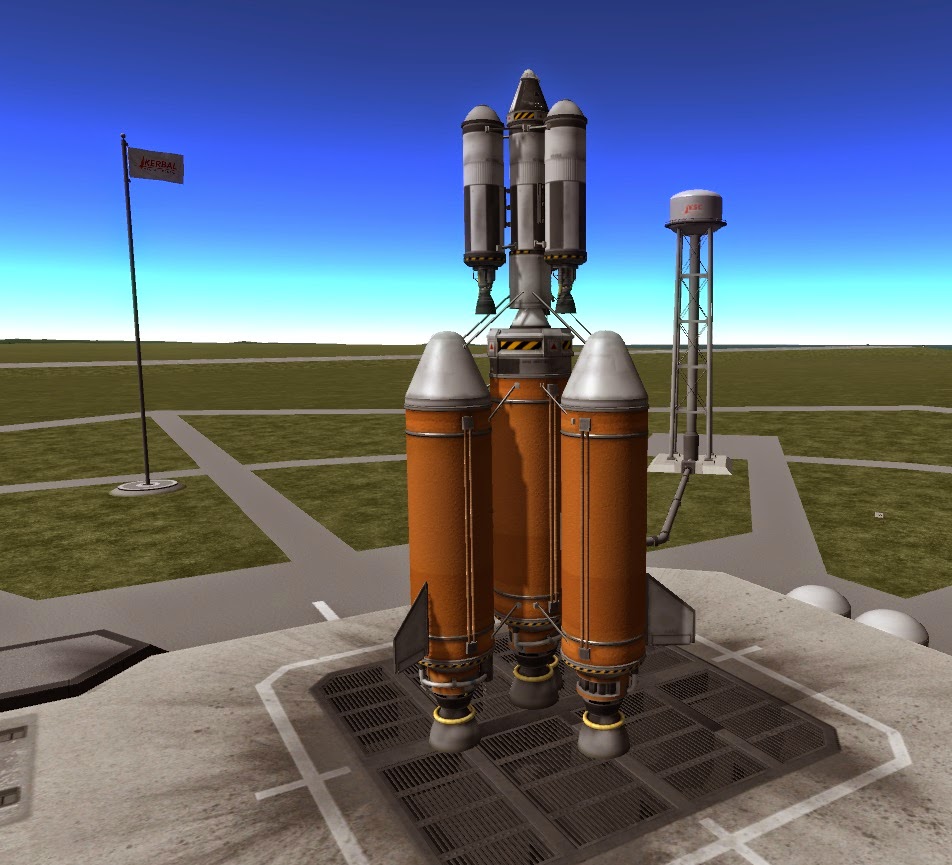
Notice it includes solar panels, landing gear, and launch stability enhancement. It even included a battery bank. Yes, this was a serious attempt at reaching the Mun. Upon pressing the spacebar, four RT-10 solid boosters fire. Once ejected, four more boosters light up. Once those are exhausted the orange Rockomax Jumbo 64 tank feeds the Skipper engine.

The transfer/lander stage is made of three FL-T800 tanks each with a tiny 48-7S engine. Landing gear is attached to each tank. The return stage is a FL-T400 tank with one LV-909 engine. I equally spaced three OX-4L 1x6 solar panels around the tank. Between the fuel tank and the Command Pod MK-1 I used a Z-1k rechargeable battery bank.

The upper stage is heavy and it flexes a lot as physics are first applied at the launch pad. I think this could have been fixed with better struts. As an inexperienced pilot at the time this craft could not reach orbit.


To The Mun


Alice:

Second in the series. It was a reworking of the To The Mun ship. Gone are the solid boosters, replaced by six double stacks FL-T800 tanks on top of a FL-T100 and a LV-45 engine. The orange tank is now supports a Mainsail engine. This craft uses asparagus staging, seven engines fire at launch. Tanks are dropped in balanced pairs as they empty until only the full orange tank is left.

The transfer/lander and return stage is the same as To The Mun with the addition of three FL-T800 tanks equipped with LV-45 engines. This change was intended to help establish circular orbit and for the Mun transfer. These engines are pretty powerful. On the rare occasion the ship held together until they fired, it tended to go out of control quickly thereafter. If only I had known to ease up on the throttle.

Because the upper stage is heavy and under strutted, the Mainsail has a tendency to push the orange tank through the ship causing total disintegration. Where the first ship seemed under powered, this one was had too much muscle for my skill level at the time.

Alice

Alice2

The upper transfer/lander/return stage is same as the Alice. Everything below is gone. The lift stage is two stacked FL-T800 tanks with a LV-30 engine. This is surrounded by eight FL-T800 tanks with LV-45 engines. Asparagus staging and a lot of struts were used. 

Going back now and looking at my earlier attempts at design, I find most of them were quite capable of completing their intended missions. Not so with this one. Originally I found this craft to be very dangerous to fly. Even now it could not make orbit with my best efforts. Had I used LV-30 engines instead of the LV-45 it might have made it.

Alice2


Alice3

The upper portion remains the same as the Alice. The lift Stage is quad FL-T800 tanks with LV-30 engines. Surrounding and using asparagus staging are four FL-T800 tanks and LV-45 engines.

Obviously, I could not get this to the Mun, or in orbit, 3 months ago or else there wouldn't be more ships in the line. Today this one surprised me. It actually flies pretty well.


Alice3

AliceC:

Why isn't this the Alice4 or AliceD? Uhm, because. OK, it is a tribute to Alice Cooper, whose action figure (It's not a doll!) is next to my computer.

The upper portion remains the same as the Alice. The lift stage is built around a central stack of one Rockomax Jumbo-64 on a Rockomax X200-16 with a Mainsail engine. This core issurrounded by four Rockomax Jumbo-64 tanks on a Rockomax X200-8 with Mainsail engines. The outer tanks use asparagus staging so all five Mainsails fire at launch and empty pairs are dropped until only the full central tank remains.

The smaller Rockomax tanks were placed under the orange tanks because I had read that doing so would prevent over heating. This was an overpowered beast of a rocket that came apart at the seams. Better strutting would have prevented this. Another issue was a weakness of KSP 0.23 and that is the connections between parts didn't always behave well. The smaller tanks wobbled and often lead to a violent but exciting end to the mission as they sent parts flying everywhere.


AliceC

AliceK

Finally, the first ship I designed and flew that actually landed on Mun. I crashed so many times trying to land. Success is sweet.

The AliceK was a complete reworking from the ground up. I decided the Mun mission should be more of a psuedo apollo style craft. I began at the top with the Mk1-2 Command Pod with chute.

The lift stage is three Rockomax Jumbo 64 orange tanks on Rockomax X200-16 tanks with Skipper engines mounted on TT-70 radial decouplers. These are angled 5 degrees by holding shift and pressing S. It gave a little more stability in flight. These use asparagus staging to central orange tank, X200-16, Mainsail combo with standard canard fins for stability. Struts hold it all together. All four engines fire at launch, dropping the outer three tanks when empty

The second stage is built around a Rockomax X200-16 tank with Skipper engine. It is Surrounded by three FL-T800 tanks with LV-T30 engines on a TT-38K radial decoupler. All four engines fire at once. Nothing is ejected until all the tanks are empty.

The third stage starts the Munar transfer. It is three double stacks of FL-T200 tanks with a LV-909 engine. Once ejected the 2x3 solar panels could be extended.

Completion of the transfer, actual landing, and the start of the Munar liftoff is handled by three double stacks FL-T200 tanks with Rockomax 48-7S engines. 6 landing struts are mounted to the central Rockomax X200-16 tank. The center tank with its LV-909 engine was used for return and reentry burns. There is a Z-4K rechargeable Battery Bank on top of tank.

AliceK - "One giant leap for kerbalkind."

Yes, it is way over designed, but that is what it took for my first landing. 

AliceK Flag onMun

Saturday, April 12, 2014

Experimental Big Boom Class

This post covers more of my early days of trying to reach Mun. I entered a mad experimental phase where bigger is better. All of these vessels have the same fatal flaw. They all lack solar panels, batteries, or electrical power generators. They might reach orbit, but it wouldn't be long before they lose all power to get back home.

The first ship I named Big Boom. Short round might have been a better name. Four orange tanks with Mainsail engines comprised the first stage. The second stage was four stacks of two FL-T800 tanks and four LV-T30 engines. This ship was difficult to control and tended to come apart during ascent. I thought it was because it was overpowered - which it was - but the real issue I repeated throughout the series and didn't realize it until writing this post. The FL-T800 tanks needed struts around the bottom to hold the stacks together. They flexed and blew apart.

Big Boom

Big Boom2 took a different approach. It was tall and lean. The lift stage was eight stacks of one FL-T800 and one FL-T400 that sit above a LV-T45 engine. The next stage was four double stacks of FL-T800 tanks on LV-45 engines. The upper stage was a double stack of FL-T800 tanks and a LV-T30 engine. When launched the vessel sways like a palm tree making flying a very dangerous adventure.

Big Boom2

The most interesting thing about this ship is it was the first I designed using asparagus staging. Using fuel lines attached first to the outer ring of fuel tanks and then to the inner tanks it is an interesting feature of KSP. All the engines on the first and second stage fire at launch. Once the outer ring of tanks are exhausted and jettisoned the inner ring tanks are once again completely full of fuel. Yeah, cool.

Asparagus Staging

Big Boom3 is nearly the same ship as Big Bang2. The outer ring of tanks are heavily strutted trying to contain the destruction and strangely it does not have asparagus staging. I have no idea why I removed the fuel lines. The craft is capable of orbit, on the rare occasion it didn't disintegrate, leaving the entire upper stage for transfer. Too bad I forgot electrical power.

Big Boom3

Mun Or Bust was a sideways attempt to end the launch problems of the previous rockets. The difference from the last craft is this one uses six double tanks on the outer ring instead of eight.

Mun Or Bust


The final entry in this class of ships is Enterprise, It is a ship worthy of the name. The lift and second stages of double tanks are removed and replaced by a single orange tank with a mainsail. There is an added small upper stage and landing gear. If I had remembered electricity it is capable of a Mun landing. Of course it might be best not to tell your Kerbalnaut he's not coming home any time soon because the lander has no return stage. James Tiberias Kermin wouldn't let that stop him.

Enterprise

The more I build and fly the more I am beginning to understand. Next time I'll present the line of ships that actually achieved my first Mun landing.

Friday, April 11, 2014

Mun Orbitor Series

The Mun Orbitor series was really just a continuation of the prior Orbitor line.

Mun Orbitor1 took the original Orbitor1 and added another FL-T800 fuel tank and solar panels. I don't recall having any of the previous vessels in orbit much less in orbit long enough to lose all power. I guess I just had really high expectations. Scott Manley could undoubtedly land this on the Mun. I did achieve orbit which was still a milestone.

Mun Orbitor1

Mun Orbitor2 was a tweaking by adding Delta Deluxe Winglets and a tiny third stage: FL-T100 fuel tank and LV-909 engine. Mun Orbitor 1 seemed pretty stable when I retested it for this post. It did have a mild roll and I guess that is what I was trying to stop with the fins. The upper stage - seemed pretty useless when I first launched, however keep reading.

Mun Orbitor2

Looking back I think the ships were pretty well thought out, especially for a beginner, and my flying skills were starting to improve to the point I was making orbit. Nowhere near circular but it was orbit.

For fun today, which is three months after original design and testing, I sent the Mun Orbitor2 back to the launchpad, hit the space bar and quickly achieved an 80k orbit. Then I transferred to Mun and set a 15k periapsis. Kind of looks like the Death Star doesn't it?

Mun Approach

It is sort of satisfying to know my original design was capable of the mission once enough flight time had been logged to gain the necessary experience. Notice in the picture above that the double tank second stage is still attached. It even had enough fuel to begin the burn towards Kerbin's atmosphere. I had almost a full tank on the tiny third stage when I began reentry. The solar panels were still extended as I started reentry.

Reentry

I retracted the solar panels before taking this side image of the reentry flames. I jettisoned the upper stage shortly after the picture was taken.

Side Burn :)

I deployed the chute when my speed dropped below 200 m/s. It opened perfectly at 500 m.

Chute

I hope you are saving your old craft files. It is pretty interesting looking back to see what was done correctly and even more interesting to find out the ship really could perform the mission.


Thursday, April 10, 2014

The Orbitor Series

After Failing to get Bob into orbit (see the Humble Beginnings post), I set about to create a design that I could get into orbit. Welcome to my Orbitor series.

The first in the series was aptly named the Orbitor1. The first stage is three LV-T45 liquid engines under FL-T800 tanks. The second stage is one LV-T30 with a FL-T800 tank.

When I first created this ship I promptly dropped it in the ocean shortly after launching. I really thought it was under powered. Today, three months later, I easily put this in orbit. Hint: Make sure you press 'T' before launch to engage the SAS. This will greatly help you maintain control. The real problem with this rocket turned out to be I was too inexperienced and needed to log more flight time.

The Orbitor1

The next evolution of the series, the Orbitor2, was to simply place the Orbitor1 atop a monster orange tank surrounded by 6 RT-10 solid boosters. The boosters fired first and once ejected the Rockomax Skipper engine took over. Except it didn't. With insufficient thrust to carry the upper stage the m/s quickly dropped until the vessel plummeted to the ocean. I could not think quick enough back then to shutdown the stage and jettison it so the upper stage could keep going.

The Orbitor2

In true Kerbal tradition the Orbitor3 added more orange tanks, engines, and wings. My early attempts were all done in Kerbal Space Program version 0.23. This version routinely resulted in poor connections between tanks and engines. This causes the craft to wobble severely. I added struts trying to control the wobble and even reduced the throttle level (the ctrl key lowers the throttle). No matter what I tried the ship eventually shook itself apart. The explosion was nice.

The Orbitor3

Orbitor4 took a step backwards. I used Orbitor2 but swapped out the Rockomax Skipper with the Mainsail, the thrust monster of version 0.23. I should have stopped there but in further Kerbal tradition I added more boosters. There are 8 solid boosters around the orange tank. Only 4 fire at a time. After they are jettisoned the next 4 light up. The mainsail was not used until after the boosters. The problem I encountered was roll. For mild roll, it can be controlled with the Q and E keys. Not with this vessel. Until the boosters were gone there was nothing that could be done to stop it.  

The Orbitor4

Since learning today the Orbitor1 was capable of attaining orbit, that means all of these ships had the potential of doing the same. Of course none of them accomplished the mission until today. Don't be afraid to fail. It is how you learn. Keep trying. It is how you gain experience.   

Did you notice I didn't use any launch stability enhancers with any of these vessels? They were not saved down with the craft file and it appears they don't really need them.

Tuesday, April 8, 2014

Humble Beginnings

This is a picture of one of the very first rockets I designed from stock parts. I say, one of, as I didn't think to save all my early attempts. Checking the save date, this was from the first day or two that I owned Kerbal Space Program. I named it Bob. I failed, and failed, and failed some more to get this into orbit back then - only a little over three months ago. I gave up on it thinking it did not have enough thrust to make it to space. Today for fun I put it on the launchpad and hit the space bar. I hit orbit so fast I was amazed. This shows my original ideas weren't all wrong. It also proves practice makes a big difference.

This ship is three stages. The first is the two RT-10 solid boosters one on each side. When they are exhausted and jettisoned the LV-T30 fires, with a tank and a half of fuel (FL-T800 and FL-T400), and establishes an orbit worthy apoapsis with enough speed to coast when the engine is exhausted. With the final stage I circularized and later set a reentry course (Rockomax 48-7S and FL-T200) . I even remembered solar panels proving this was not my very first rocket. The chute brought me safely down into a mountainous rain forest area near the ocean. What once was impossible is now a Sunday drive. Actually its Tuesday but you know what I mean.

In the three months since gaining orbit, I have built many ships that were way more poorly designed than my first humble craft. I'll discuss some of them in upcoming posts. Each failed for different reasons. With some, I made the upper stages too heavy, resulting in wobbly rockets that collapsed and exploded as soon as physics were applied on the launchpad. Often, I did not use proper struts to hold it all together and the craft would rip apart early in the ascent. Sometimes, though more rarely than you might imagine, the launch stage was under powered. Another common mistake occurred when engines, decouplers, or launching clamps, were incorrectly located in the design tree. That last one is a tough one to learn to watch out for but easy to fix.

Once I improved my design skills, I was able to land on Mun and Minmus numerous times, sometimes with tiny rovers. Next I travelled to Duna. Afterwards, Moho. I did not know it was supposed to be really hard so I just did it. Each step of the way it seemed I littered the surface of each with rocket and Kermin parts before a mission accomplished the near impossible of not killing Bill or Jebediah and only left them stranded. This only happened if they had respawned after their last mission. For me, the adventure came in trying to design a vessel that could go and rescue the brave souls. When I succeeded I  would move on to the next. I have to admit though that there is a pretty big junk yard of vehicles on Duna as rescue ships piled up.

After learning and admitting my current limited abilities, I planted an unmanned ship on Eve. I sent an unmanned craft because I haven't figured out how to build a ship with enough power to launch through Eve's atmosphere. Next I sent a vessel to Ike, the moon of Duna, and one to Gilly, the moon of Eve. These were done without needing a rescue mission. That does not mean some early attempts wouldn't have needed rescuing - had they survived, but the important point is science was learned and we grew in our design and planning skills.

Later I sent a lander to Dres. The poor Kerbalnaut almost ran out of Twinkies while I developed a rescue mission. That is when I learned about the canyon. Visible from orbit, it cuts a slit just south of the equator. I had to go there. I had to take a dune buggy ride down into it. So I had to develop a worthy rover. It couldn't be like the tiny ones I had used on Minmus. This one had to be able to take a beating and stay on its wheels. That is when I came up with the rover seen in my banner. I have used the design multiple times. Finally, I have sent a lander and rover to Eloo the big golf ball in the sky.

Soon I will be going to Jool and its five moons. I'll bring back pictures when I do. I will also be discussing some of the missions I have just mentioned and the designs I had to come up with to make them happen.

Monday, April 7, 2014

Everything Seems Impossible… Until You Do It

The learning curve for Kerbal Space Program is really steep. It reminds me of when I first tried to learn to play guitar. Learning those first three chords, so I could play just the simplest of songs, seemed to take forever. It seemed impossible, but I kept at it until one day I did it. With a little more practice playing those three chords became something I could do without thinking about it. The next few chords were even harder. When I got to the F chord I almost gave up. Yep, impossible I thought, and then I did it. Amazing!

Learning Kerbal Space Program is the same way. Sure there are those short tutorials included that seem easy enough, but then when I fired up in sandbox mode, building a rocket was suddenly really confusing. Eventually, I sent my first creation to the launch pad, only to have it disintegrate moments after hitting the space bar. More building led naturally to more explosions. It felt like a success when I finally made it to tumbling out of control. If you are learning the game, you understand.

I did not give up. Once I started designing better balanced craft and started to fly with some control, I quickly learned about Delta-V or more precisely the lack thereof. Almost reaching space doesn’t quite count except as another milestone. A few additional boosters later and I reached orbit. It was nowhere near circular but it was orbit.

You get the idea. Everyday is new growth. When things go horribly wrong I use it as an opportunity to learn new skills in design and planning. My humble beginnings with this game have given me a whole new respect for the work of real space travel. It seems impossible until someone does it.

Saturday, April 5, 2014

In The Beginning....

I was given Kerbal Space Program for Christmas. I have become kind of addicted. When I talk about my latest space adventure with my wife she just rolls her eyes, and my friends only pretend to listen. I am used to it. You see I am also addicted to tea... wait, don't glaze over! Keep reading. With my love for tea and lack of family and friends who share my passion, I turned to blogging. I now run a successful blog with thousands of hits per month and I am no longer alone in the tea world any more. I imagine you probably didn't even know there was a tea world, did you?

So now, my hope through blogging, is to find others who share my love of this cool space program simulation software. I hate to call it a game because it is much more to me. Simply put it is amazing. I find watching Duna rise over the horizon while landed on Ike is breathtaking. When I gaze into the canyon on Dres I am inspired. I also have to admit racing a rover across the surface of Eloo is just plain fun. I want to share these moments with others who actually understand why I am so fascinated by them. 

I hope you not only join me on my Kerbal Space Program adventures, I hope you will share your own adventures with me. So this is how it begins. Where it goes next, who knows, but it probably will involve several attempts going horribly wrong, for Jebediah Kermin, before he finally triumphs. Everything in KSP seems impossible... until you do it.